DayZ Badlands animals: Nasdara Wildlife Breakdown
Meet Nasdara's DayZ Badlands animals: mouflon, guard dogs, and desert monitors, plus habitats and hunting tips.
A military yard in Nasdara can go quiet for all the wrong reasons. DayZ Badlands animals are not background filler on this map; they decide whether a loot run feeds you or ends with a pack of dogs at the gate. If you want a clear picture of DayZ Badlands animals before you cross the Dasht-e Sarman, start with the three species built for the region: the mouflon, territorial dogs, and the desert monitor.
Those three were laid out in the studio's Week 86 development notes, which framed Badlands wildlife the way Frostline framed cold-weather creatures: regional animals, different interactions, different loot. Nasdara is dry, mountainous country pressed in by desert, so the roster leans on a steppe grazer, base-guarding canines, and a reptile that actually belongs in the sand. The DayZ Badlands animals roster is small on purpose. One reviewer who walked the map still wanted more wildlife and more natural food, which makes every confirmed animal worth learning before you burn your water on an empty crossing.
What Nasdara's New Wildlife Is For
The new creatures were chosen because they fit the setting and because each one plays a different role. Mouflon belong to the mountains and steppes of Central Asia. Dogs break the usual predator-or-prey split and become the first territorial animal in DayZ. The desert monitor is the map's signature species and is described as possibly the series' first reptile.
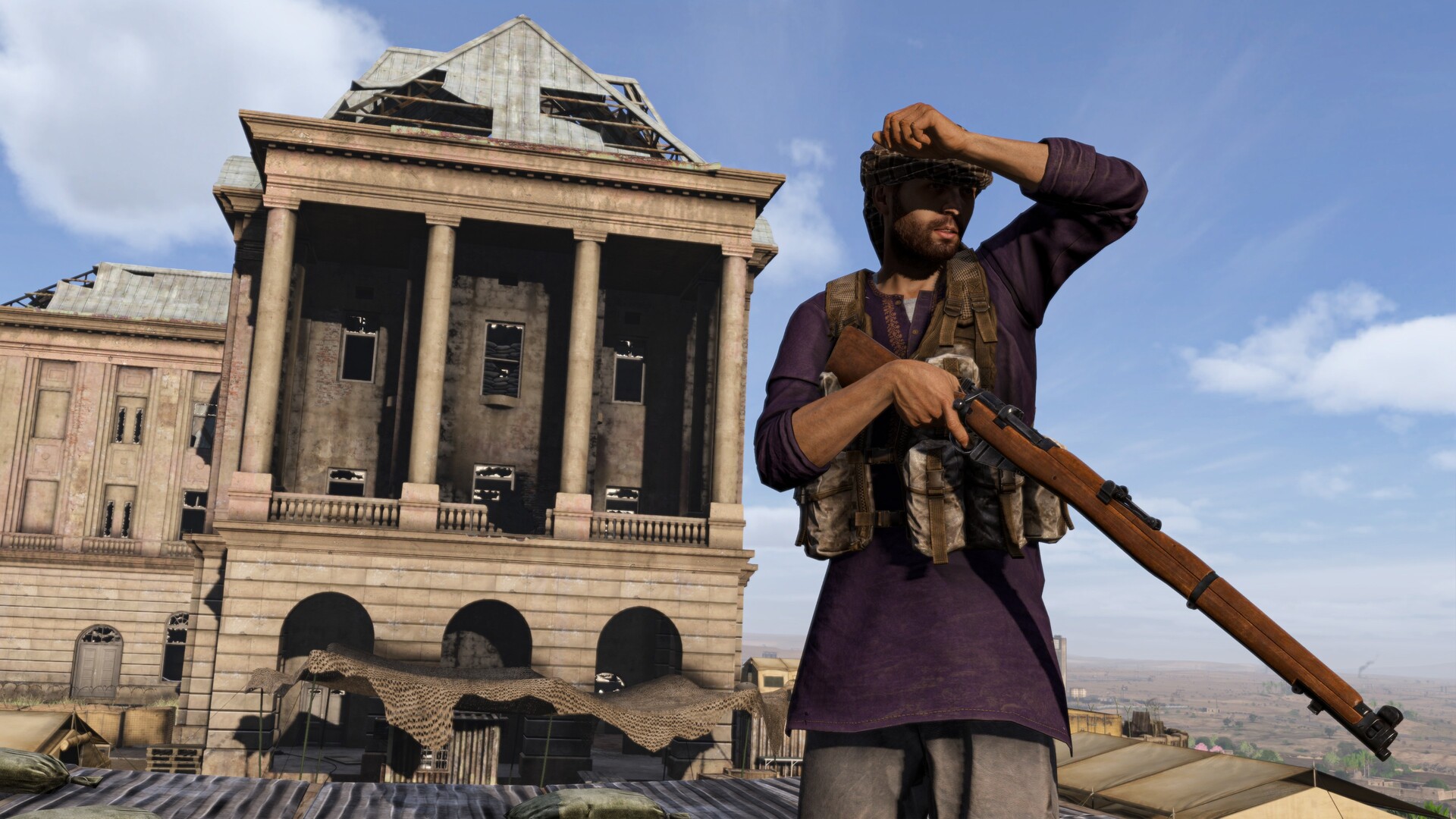
Official screenshot · Source: Steam store
That signature-animal pattern is already familiar from the other official terrains. Chernarus has the regal buck, Livonia has the brown bear, and Sakhal has the white wolf. Nasdara's counterpart is the desert monitor. The pattern is a map-reading tool: the lizard is ambient desert life you are meant to notice and hunt, not a boss with a health bar.
| Official map | Signature animal | What it tells you |
|---|---|---|
| Chernarus | Regal buck | Temperate forest, classic hunting prey |
| Livonia | Brown bear | Dense woodland and a serious predator |
| Sakhal | White wolf | Cold country and a roaming threat |
| Nasdara (Badlands) | Desert monitor | Arid ground and a skittish, huntable reptile |
Behavior details below follow design intent from the official DayZ Badlands development blog. Anything a player later claimed to have crafted or spotted is marked as player experience, not as a published drop table.
DayZ Badlands Animals Compared
These DayZ Badlands animals split into three jobs: high-country quarry, fixed guards, and desert food that runs. Use the card as a field reference. It sticks to what was actually stated, plus the gaps the studio left open on purpose.
| Animal | Role | Where it lives | What you can count on |
|---|---|---|---|
| Mouflon | Regional animal with its own loot and interactions | Mountains and steppes | Habitat is confirmed; exact drops were not listed |
| Dogs | Territorial guards, not roaming hunters | Tied to places, especially military zones | They attack if you enter their territory; you cannot tame them |
| Desert monitor | Ambient reptile and food source | Dasht-e Sarman Desert and nearby ground | It flees when it sees you; meat is confirmed, extra loot was only teased |
A few boundaries matter more than damage numbers nobody published. Dogs are not wolves. Wolves roam and hunt. These dogs stay with a location. Monitors are not described as ambush predators. They bolt the way other ambient animals do, and you hunt them rather than the other way around. Mouflon are the least documented of the three, so do not plan a calorie route around a butcher list that was never released.
| Claim | Status | Where it comes from |
|---|---|---|
| Mouflon suit mountain and steppe country | Confirmed design | Dev blog |
| Dogs cannot be tamed or kept as pets | Confirmed | Dev blog |
| Dogs attack when you breach their territory | Confirmed | Dev blog |
| More complex dog behavior is coming | Planned, no date | Dev blog |
| Monitors can be hunted for food | Confirmed | Dev blog |
| Monitors have further rewards | Teased, not itemized | Dev blog |
| Lizard-skin belts, sheaths, and hip packs | Player experience | Map review |
| Lizards around an eastern oasis | Player experience | Map review |
Mouflon on the Mountains and Steppes
The mouflon showed up in teasers before the full animal post. It is described as an animal of Central Asian mountains and steppes, which fits Nasdara's high country better than another forest deer would. In the real world a mouflon is a wild sheep with heavy curled horns. On this map, read it as a rugged grazer you would expect above dry riverbeds, not in the empty eastern sand.
The notes group all three creatures as sources of different interactions and loot, then spend the specifics on dogs and lizards. Until a patch note or a repeatable in-game test says otherwise, treat the mouflon as an animal you find, hunt, and loot in the mountain-steppe band. Stop there. Inventing pelt counts or steak yields is how survivors plan a meal they never get.
Player experience from a full-map review adds context without filling that gap. The eastern true desert was described as almost lifeless aside from an oasis, lizards, and a Chinook-style helicopter crash. That pushes larger mammals, including anything sheep-like, toward the mountains and the less barren interior. Mud-brick towns can look alike at a distance, so unique landmarks matter, and the same logic applies to animals. If the slopes are where mouflon belong, glass those slopes before you commit to a long dry walk.
Keep the hunt cheap:
- Scan ridgelines and steppe edges instead of expecting a flock beside every road.
- Do not chase a distant shape if your water is already low. The desert punishes the extra kilometer.
- Process a kill somewhere with cover. Open ground is where other players, and dog packs near military sites, become the real problem.
- Write down what you actually receive. Community drop lists for this animal are still thin.
Territorial Dogs at Military Sites
Dogs are the sharp edge of the roster. They are a new animal type that sits between predator and prey, and they are the first territorial animal DayZ has added. A wolf might cross your path and keep moving. A Badlands dog is attached to a home turf. Military zones are the example the developers gave.
Two breeds are in: the Doberman and the German Shepherd, each with multiple variations. That is a visual tell as much as a lore detail. If you hear barking near a compound and see a shepherd or a doberman instead of a wolf silhouette, you are probably already inside an old perimeter.
| Breed | What was confirmed | How to read it |
|---|---|---|
| Doberman | One of two breeds, with variations | Short-coated military look; any pack on site is hostile |
| German Shepherd | One of two breeds, with variations | Classic working-dog profile; same territory rules |
| Both, in packs | They stay near former owners and old posts | Expect a group, not a single wandering pet |
The backstory is bleak and useful. These dogs were wrecked by the events of Day Zero, stayed loyal to the people who kept them, and never really left. The studio's line is that they are still man's best friend in the worst sense: loyal to owners who are no longer alive. They hang close to those old posts and move primarily in packs. Breach the territory and they attack.
You cannot tame them. You cannot keep one as a companion. That question was shut down on purpose. The team also said players can still make use of the dogs however the systems allow, which is not an official pet mechanic. Richer behavior than a straight attack is planned, and there is no ETA. Until that update exists, plan for aggression at the boundary. Do not plan for a warning minigame that has not been described.
Of the DayZ Badlands animals, dogs are the ones that punish greedy loot routes. A reviewer who liked the map still described the push toward better military gear as intense, largely because natural cover is thin. Stationary packs on military sites make those exposed gaps worse.
- Assume a quiet base may be quiet only because the dogs have not seen you yet.
- Do not file a bark under random ambient noise the way you might file a distant bird.
- Pick an exit before you vault the wall. A pack tied to the site will not wander off like a roaming wolf.
- On a new server, watch whether the same compounds stay guarded after a restart. Fixed residences fit the design, but a full zone list was never published.
- Do not build a strategy around befriending them. That system is not in the design.
Desert Monitors, Food, and Fieldcraft
The desert monitor is the animal the team wants you to remember. It is framed as Nasdara's representative creature and as possibly DayZ's first reptile. Most of them live in the Dasht-e Sarman Desert and the ground around it. Spot one and it should run, same as other ambient wildlife. Hunting them for food was already hinted in teasers and then confirmed in the write-up. Other interesting rewards exist, and the studio refused to list them.
That last point is where player experience helps, with a label on it. A map review showed craftable lizard-skin belts, sheaths, and hip packs alongside other region-only gear. Those items line up with the "go find out" tease, but they come from a player video, not from an itemized blog table. If you are hunting specifically for wearable lizard gear, confirm the recipe on your current build. Early crafting lists move.
Hunting DayZ Badlands animals for calories is a patience loop here, not a boss loop:
- Work the Dasht-e Sarman belt named by the developers, plus oasis edges in the eastern desert if player experience on your server matches the review.
- Move slowly enough to see a low, camouflaged body before it runs. Look for a patterned shape, not a deer-sized blob.
- Take the shot or the swing only when you can recover the body. A monitor that reaches the rocks is a wasted calorie.
- Cook the food you came for, then check the carcass for hide or other parts before you leave it.
- If skin recipes exist, craft the small goods back in shelter. Do not stand in open sun inventing a workbench.
The art notes explain why the lizard is readable at all. Designer Jana Unzeitigová led the research on real behavior for modeling and animation. Artist Václav then built the animal at a believable scale so it would not tower over the world. Head scales differ from body scales. Camouflage, including stripe patterns, was tested against that skin. The hard part was DayZ's visual style: realistic enough to belong, clear enough to see. Scales are slightly larger than life on purpose, both for the engine and for your eyes. The team also refused to mash several lizard families together. The target was a desert varanus that belongs on a desert map.
That choice has a gameplay consequence. A correctly sized, well-camouflaged monitor is easy to miss in glare and scrub, which is why the scales were enlarged. If your brightness is crushed for a cinematic look, you will walk past food. Raise visibility before a long desert crossing.
A route that respects the roster
DayZ Badlands animals still leave large stretches feeling empty. That is player experience from a reviewer who wanted more wildlife, more natural food, and a higher population than a reported 60-player stability cap. Do not expect a meal under every bush. Plan calories the way you plan ammo.
| Priority | Do this | Why it matches the design |
|---|---|---|
| 1 | Learn a military perimeter before you loot it | Dogs are tied to sites and attack on a breach |
| 2 | Hunt monitors in the Dasht-e Sarman, not random forest | That is the published habitat |
| 3 | Glass mountains and steppes for mouflon | The Central Asian range is the firm location clue |
| 4 | Carry water for the hunt, not just a rifle | The walk is the limiter, not a published health value |
| 5 | Separate dev facts from crafting clips | Extra lizard loot was teased, not fully itemized |
A simple session keeps the roster useful. Player experience puts fresh spawns in the north, with better military gear farther south. While your kit is still light, take safe food from monitors on desert fringes and any mouflon you can approach without a marathon. Save dog sites for when you actually need what is inside them. Check patch notes after big updates. Dog behavior is supposed to grow past a straight attack, and no date was given. Until then, the safe read stays simple: mouflon in the high country, monitors in the sand, dogs at the places people used to defend.
FAQ
Which DayZ Badlands animals are actually dangerous?
Dogs are the confirmed threat. They guard specific locations, mainly military zones, and they attack if you enter that territory. Desert monitors flee once they notice you. Mouflon are presented as regional wildlife, not as hunters. On open ground, other players are still the larger danger.
Can you tame the Dobermans or German Shepherds?
No. The developers stated that taming and companion pets are not the design. The dogs stay in packs near old owners and old posts. Any community workaround is unofficial and can break on the next patch.
Where should you look for desert monitors?
The published range is the Dasht-e Sarman Desert and the surrounding area. Player experience also places lizards near an oasis in the barren eastern desert. They run when alerted, so search before you sprint, and watch for the enlarged scale pattern rather than a large silhouette.
What loot do the new animals give you?
Monitors can be hunted for food, and the developers said there are further rewards they wanted players to discover themselves. Player experience reports craftable lizard-skin belts, sheaths, and hip packs. Mouflon are grouped with the new loot-bearing animals, but exact yields were not published. Dogs are a hazard first, not a farming target.
Related Guides
DayZ Badlands dogs: Guard Breeds and Survival Tips
DayZ Badlands dogs guard Nasdara bases. Learn breeds, behavior, loot-run tactics, and what server owners should watch after launch.
DayZ Badlands base building: a Nasdara rebuild guide
Plan DayZ Badlands base building in Nasdara: rebuild houses, mix brick and wood, and keep code locks alive.
DayZ Badlands early access: launch and features
DayZ Badlands early access notes meet the live 1.30 wipe: heat, water, sandstorms, bikes, and what creators could not confirm.
DayZ Badlands izurvive Nasdara Satellite Guide
Use the DayZ Badlands izurvive Nasdara map to filter loot, mark squad routes, and learn districts after the 1.30 wipe.
DayZ Badlands gold AK: Palace Loot Hunt Guide
Day-one palace route notes for the DayZ Badlands gold AK, plus what the 1.30 launch confirms about desert loot and survival.